

There are various language styles we use depending on the situation or forum we are in. Common language, informal language and formal language pretty much sums up the most common ones.
The lesson on language is indelibly printed in my mind since a few weeks following my 12th birthday pool party. It was a hot December and I had a bunch of friends over to celebrate, and we fooled around in the pool, squealed and giggled and apparently (according to my speech and drama teacher who lived next door), swore!
Oops! Young girls using expletives at a volume loud enough to land clearly on the ears of my speech teacher! It was school holidays, we were free and relaxed and uninhibited. It’s not as if we spoke like that at school! And, we were friends. The language we use when we’re with friends is “common and informal language”. Common language sees the use of abbreviated speech, short cut sentences, and low language – such as swear words like “crap”. At school is where you flow between informal and formal language as you go from the playground to classroom and back again. I’m sure the word “crap” was spoken but certainly not in a class room, because by the age of 12, we inherently knew how to choose our language according to our circumstances.
At my next speech lesson, and at the conclusion of the lesson, my speech teacher asked:
Teacher: “Did you enjoy your party darling?”.
Me: “Yes I did, it was so much fun” – articulating as clearly as I could.
Teacher: “Darling, when you speak, no matter where you are or who you are with, always make sure you speak well”.
In an instant, I wanted the floor to engulf me! I knew exactly what she was referring to and from that moment on, I have never forgotten the lesson.
My speech and drama teacher had a licentiateship in The Art of Speech, from Trinity College of London. In her heyday, in the early 70’s she taught Australia’s Prime Minister, Sir William McMahon – a claim to fame that she was certainly most proud of. She would say “a government car would come to collect me and take me to his office”. Apparently, he had a speech stutter that required intense work to overcome however her work with him extended beyond that, assisting him with speech writing and delivery.
“no matter where you are or who you are with, always make sure you speak well”
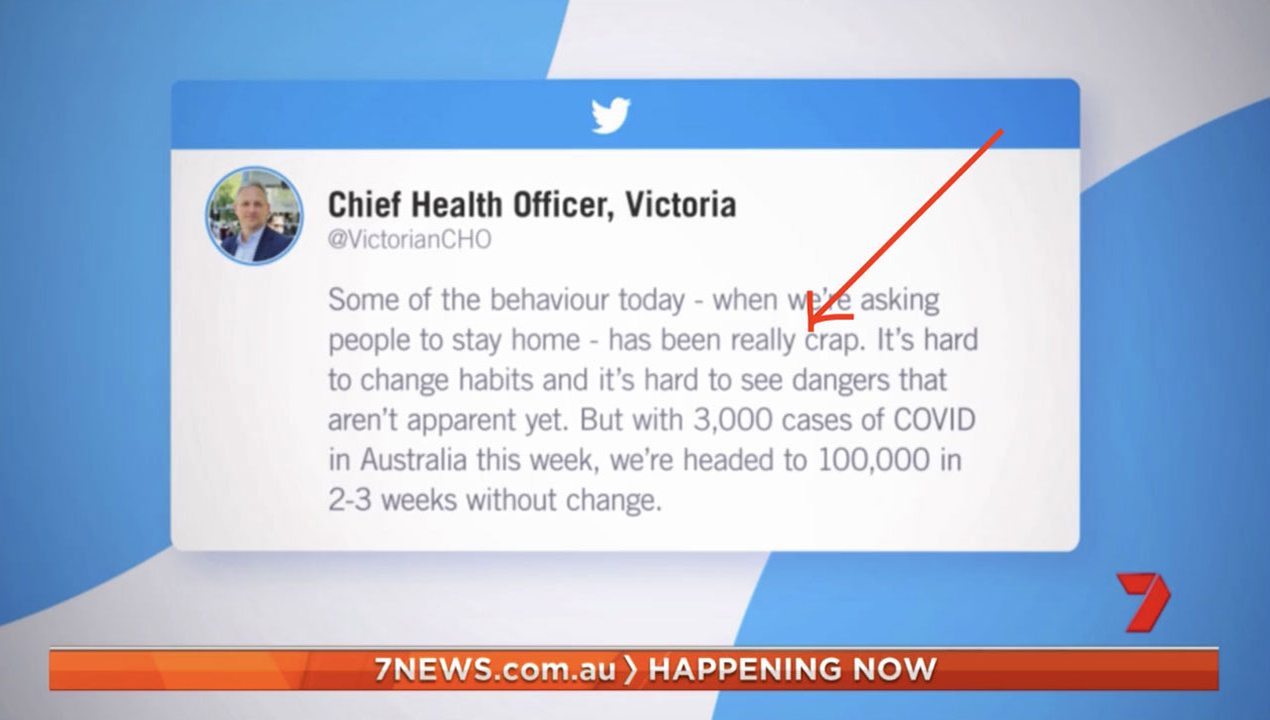
If only the Victorian Health Minister would seize the help of a tutor to guide him on his language. In todays Channel 7 news, he stated in a written bulletin addressing his concerns of the non compliance of social distancing protocol “some of the behaviour today – when we’re asking people to stay home – has been really crap”.
Oh dear! What a disastrous statement. Beyond the crassness of the word and phrase is the ambiguity and contradiction in the message given the context where it followed a request by the Prime Minister to “stay at home as much as possible” this weekend. Essentially, this informal language used by the Prime Minister is telling Australians that it’s up to their own discretion whether they stay at home or not. If he wanted ALL AUSTRALIANS TO STAY HOME EXCEPT FOR URGENT SUPPLIES OR MEDICAL REASONS, then a clear directive such as that should have been spoken. This is clear and appropriate language that would have seen behaviour positively impacted.
The real power of speech sits in the choice of words and language used. Simple, really. Words either attract or repel, motivate or demotivate, offend or encourage. Common language like this, that is used in a formal forum by someone in a senior leadership position, is simply inappropriate, making it offensive. Offensive language de-motivates people and repels. Effectively, this statement used by the Victorian health Minister has merely added to the problem of Australian’s “tuning out” to directives and not adhering to Social Distancing protocols. And the growing problem stems almost entirely from the messages given by our leaders in the the first place, give or take a few renegades.
In times of pandemic, word choice and language choice in speech is absolutely imperative to get right. If you don’t, you risk sending the wrong message and negatively impacting people instead of positively moving them in the direction you desire.
What does your language say to your clients, staff and teams? Are you using appropriate language for the setting? And do you positively or negatively impact them? At times like this, how you communicate is vitally important as well as the regularity by which you communicate.
Sam Buckingham has worked as a television presenter for over 20 years. She is a public speaking expert and speaker trainer. Sam helps individuals and businesses communicate their message with impact and ease, bolstering their reputation and brand. Sam is an expert at video communications and coaches leaders to present on camera with confidence and stewardship.
WEBSITE UNDER CONSTRUCTION.
You can reach out to me to discuss how we can work together to ensure your message and delivery is tight.